Literacy
At Strathfieldsaye Primary School, our English program is aligned with the Science of Reading and the Victorian Curriculum 2.0, ensuring that all students receive explicit, evidence-based literacy instruction from Foundation to Year 6. We use a whole-school approach, teaching reading, writing, spelling, grammar, comprehension, speaking and listening skills systematically and consistently across all year levels. This structured approach equips students with the knowledge and skills they need to communicate confidently and effectively, both in school and in the broader community.
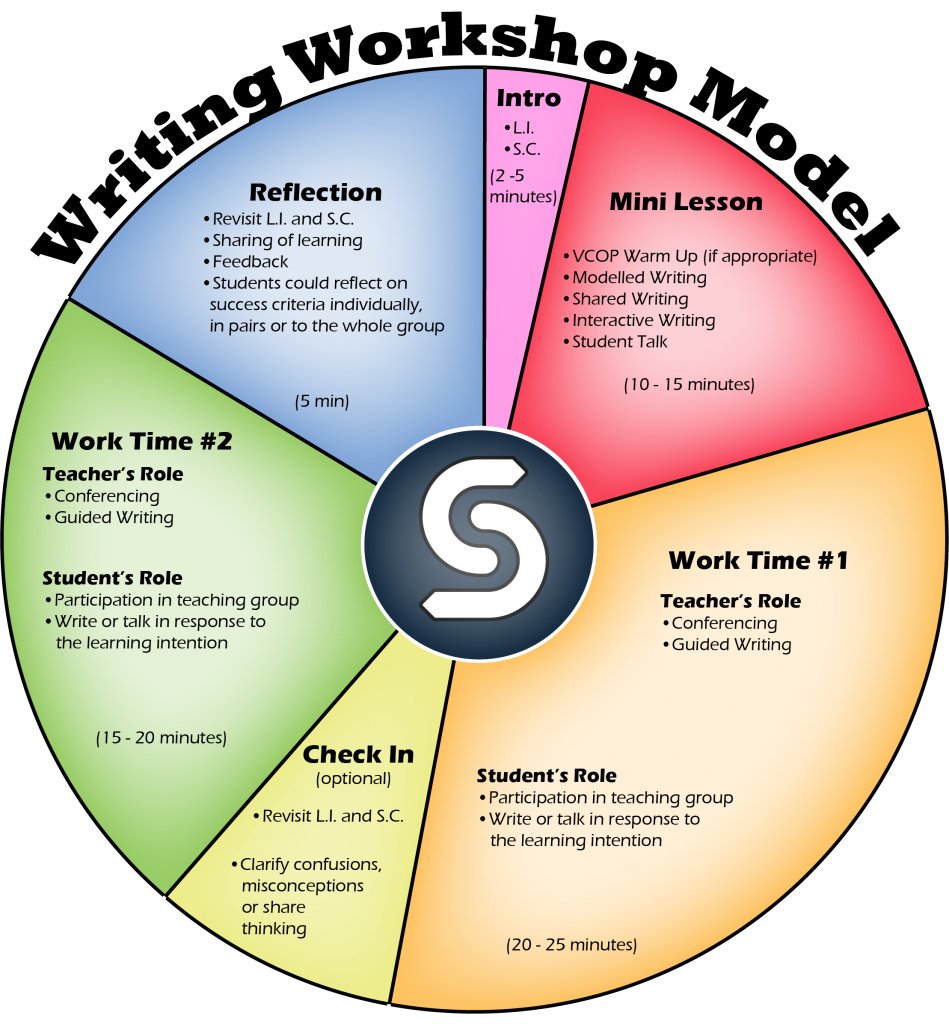
A typical literacy session begins with a whole-class focus, where the teacher models reading and writing strategies and demonstrates how to approach texts and writing tasks. Students then work individually or in small groups to practise and consolidate these skills, applying what they have learned in meaningful ways. Sessions conclude with opportunities for students to share their learning and reflect on their progress.
We use a range of research-based programs and teaching strategies to engage students and support their learning, including:
- Reading Workshop
- InitiaLit (Foundation – Year 2)
- Writing Workshop
- 6 + 1 Traits of Writing
- SpellEx (Years 3–4) and Victorian Department of Education Spelling, Grammar and Punctuation lessons (Years 5–6)
Reading and Viewing
English instruction at Strathfieldsaye Primary School is now based on the Science of Reading (SOR) and aligned with the Victorian Curriculum 2.0. The Science of Reading refers to the extensive body of research on how students learn to read and the types of instruction that are most effective in developing skilled, confident readers.
Our program promotes development in key areas of reading and viewing, writing, speaking and listening as outlined in the Victorian Curriculum. Literacy skills are taught daily and during this time students are exposed to a wide range of knowledge rich texts and vocabulary.
As explained by the Simple View of Reading, learning to read requires two overarching abilities – correctly identifying words (decoding) and understanding their meaning (comprehension). Acquisition of these two broad abilities requires the development of more specific skills.
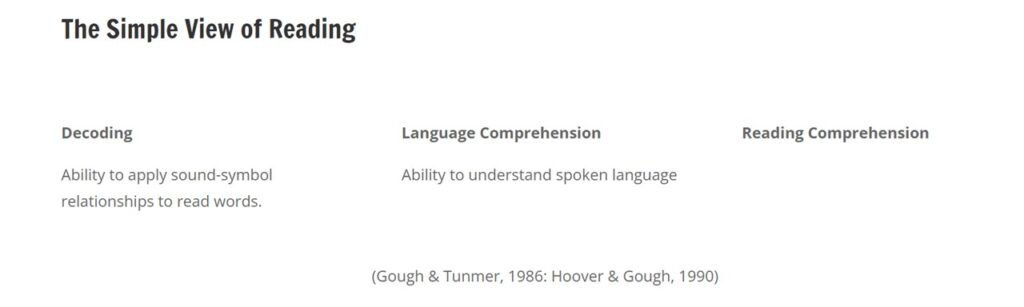
An extensive body of research on reading instruction shows that there are five essential skills for reading and that a high quality literacy program should include all five components. These five components need to be explicitly taught, in addition to providing a strong foundation in oral language and a knowledge– rich curriculum.
Five essential skills for reading:
- Phonemic Awareness: The ability to identify and manipulate the distinct individual sounds in spoken words
- Phonics: The ability to decode words using knowledge of letter-sound relationships
- Fluency: Reading with accuracy, speed and expression.
- Vocabulary: Knowing the meaning of a wide variety of words and the structure of written language
- Comprehension: Understanding the meaning and intent of the text
Foundation – Year 2
InitiaLit is used in the early years to systematically and explicitly teach the basic alphabetic code. It incorporates the key components necessary for early reading instruction, and evolves through the years to provide an explicit and effective model for teaching reading, spelling and rich language instruction using children’s literature.
InitiaLit F
Implemented across four terms, InitiaLit–Foundation (InitiaLit–F) offers an explicit and effective model for teaching reading and related skills to children in their first year of school in a fun and engaging way.
InitiaLit–F focuses on two main components:
- Phonics, to systematically and explicitly teach the basic alphabetic code in a set sequence. In addition to learning letter-sound correspondences and how these are applied to reading and spelling, children will be introduced to common morphemes and simple grammatical concepts.
- Vocabulary, oral language and listening comprehension through quality children’s literature. Detailed lessons, including writing tasks, are provided for each of the storybook titles selected for use with the program.
InitiaLit-1
InitiaLit–1 continues on from InitiaLit–Foundation in providing an explicit and effective model for teaching reading, spelling and related skills to children in their second year of school. As in InitiaLit–F, InitiaLit–1 focuses on the two main components of:
- Phonics, to systematically and explicitly teach the basic and advanced alphabetic code in a set sequence. In addition to learning letter-sound correspondences and how these are applied to reading and spelling, children will be introduced to common morphemes and simple grammatical concepts.
- Vocabulary, oral language and listening comprehension through quality children’s literature.
InitiaLit-2
By Year 2, most children will be well on their way to reading independence. The program builds on the skills taught in InitiaLit–F and InitiaLit–1, with the focus shifting now to consolidating children’s reading and spelling skills, working specifically on reading comprehension, fluency, spelling and vocabulary.
InitiaLit–2 has four main components:
- Spelling. This component reviews phoneme-grapheme correspondences and spelling concepts taught in InitiaLit–1 and teaches the remainder of the advanced alphabetic code systematically and explicitly. Children will also learn new spelling rules and morphological concepts.
- Reading comprehension and fluency. In this component, children will be taught comprehension strategies explicitly and how to apply them to different types of text.
- Grammar. Children will be explicitly taught key grammatical features and how to apply them to a writing task.
- Vocabulary, oral language and comprehension through children’s literature.
Years 3 – 6
From Years 3–6, our literacy instruction is informed by the Science of Reading and aligned with the Victorian Curriculum 2.0. As students’ decoding skills become more secure, the focus naturally shifts towards the aspects of reading most important in upper primary — namely fluency (accuracy, reading rate and prosody), vocabulary development and comprehension, while continuing to attend to phonics and phonemic awareness as needed.
These components are addressed through a structured and consistent whole-school approach that includes:
- Quality mentor texts – including picture story books, novels, non-fiction texts and visual literacy.
- Fluency and prosody practice – including paired reading throughout all classrooms, focused on building accuracy, appropriate reading rate and expressive reading (prosody).
- Explicit vocabulary instruction – taught directly and reinforced through rich texts and classroom discussion.
- Comprehension strategy instruction – supported through modelling, think-alouds and guided practice with increasingly complex texts.
Students engage in a variety of reading experiences during the week, such as:
- Partner reading
- Small group or reciprocal reading with a teacher
- Literature circles (book club)
- Independent reading with individual reading goals
- Targeted activities linked to the learning intention and success criteria
Teachers and students work together to set personal reading goals, monitor progress and celebrate growth. Our aim is to strengthen each child’s reading accuracy, fluency and expression; build deep comprehension; expand vocabulary; and inspire a lifelong love of reading.

Reading Intervention
At Strathfieldsaye Primary School, we use MultiLit’s intervention programs, MiniLit and MacqLit, to improve the literacy skills of ‘at-risk’ readers.
MiniLit is an evidence-based, explicit and effective early literacy intervention program for teaching reading skills to children who are in the bottom 25% of the expected range for their age group in Year 1 or 2. Students focus on learning the basics of letter/sound knowledge, decoding skills for Consonant, Vowel, Consonant (CVC) words and word attack knowledge of commonly used digraphs.
MacqLit is for older low-progress readers that need to develop rapid, automatic and efficient word recognition strategies. The primary focus of MacqLit is on phonics, or word identification, supported by connected text reading to ensure skills are generalised to authentic reading experiences.
Spelling
Foundation – Year 2
Spelling in the early years is taught explicitly through the InitiaLit program. InitiaLit provides a structured, systematic and cumulative approach to teaching spelling as part of early reading instruction. Children learn the essential building blocks of written English through daily lessons that include:
- Letter–sound relationships taught in a clear sequence
- Learning to blend sounds to read words and segment sounds to spell them
- Understanding common spelling patterns and increasingly complex parts of the alphabetic code
- Developing word knowledge, including high-frequency words, simple grammar and early morphological concepts
This evidence-based foundation ensures that all students build strong and accurate phonics and spelling skills before moving into the more complex word study in the middle and upper primary years.
Years 3 and 4
In Grades 3 and 4, students participate in MultiLit’s SpellEx program, a comprehensive whole-class spelling program designed specifically for middle primary. SpellEx continues the explicit, systematic approach established in F–2 and helps students make sense of English spelling by teaching the three essential strands of word knowledge:
- Phonology – the sounds in words
- Orthography – spelling patterns and conventions
- Morphology – meaningful word parts such as roots, prefixes and suffixes
Rather than relying on memorisation or weekly lists, SpellEx teaches students to understand why words are spelled the way they are. The program includes:
- Lessons are taught in a clear, planned order so students gradually build strong and confident spelling skills.
- Teachers follow consistent routines that make learning predictable, supportive and engaging for all students.
- Fun characters—Stella the Super Speller and Eddy the Editor—help children remember spelling rules, patterns and word-building strategies.
- Students learn how to apply their spelling knowledge in meaningful ways, especially when writing in the classroom.
By the end of Year 4, students have a solid grasp of English spelling structure and can apply strategies independently, across all areas of the curriculum.
Years 5 and 6
SpellEx for upper primary is currently in development, so our Grade 5 and 6 students follow the Victorian Department of Education’s explicit Spelling, Grammar and Punctuation lessons, aligned with the Victorian Curriculum 2.0.
These units broaden and deepen the knowledge built in earlier years by focusing on:
- Advanced word structure, including roots, Greek and Latin origins, and a wide range of prefixes and suffixes
- More complex spelling patterns, including multisyllabic words and less common letter combinations
- How words and sentences work, such as clauses, conjunctions, tense, expanded noun groups and sentence complexity
- Editing and proofreading skills, strengthening students’ ability to apply spelling knowledge accurately and independently in their writing
Writing
We encourage our students to become fluent and expressive writers by exploring a diverse range of text types and purposes for writing. Across the school, we incorporate ‘The 6+1 Traits of Writing’ to teach the most important qualities of good writing – Organisation, Ideas, Voice, Word Choice, Sentence Fluency, Conventions and Presentation.
Ideas
Ideas are the heart of the message, the content of the piece, the main theme, together with the details that enrich and develop that theme. It includes being able to find a topic, focus the topic, develop the topic and use details to support the content.

Organisation
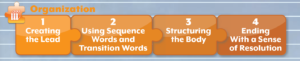
Organisation is the logical structure and pattern of ideas within a piece of writing. It refers to the order of ideas and the way the writer moves from one idea to the next.
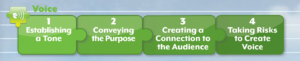
Voice
Voice is the ‘soul’ of the piece and what makes the writer’s style distinctive. It is the expression of the writer’s personality through words.
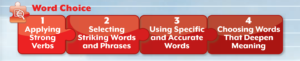
Word Choice
Word choice involves the use of rich, colourful and precise language. Authors will make particular choices of vocabulary to suit their purpose/genre.
Sentence Fluency
Sentence fluency is the rhythm and flow of language, the sound of word patterns, the way the writing plays to the ear – not just the eye. It includes sentences which vary in length, beginnings, structure and style.

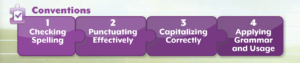
Conventions
The Conventions trait is the mechanical correctness of the piece and includes five elements: spelling, punctuation, capitalisation, grammar/usage and paragraphing.
Presentation
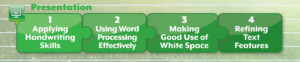
This is the ‘+1’ trait which simply refers to the fact it was introduced after the first 6 were identified. Presentation combines both visual and textual elements. It is the way we exhibit or present our message on paper. It includes balance of white space with visuals and text, graphics, neatness, handwriting, font selection, borders and overall appearance.